Small Branding Compromises, Catastrophic Consequences: Understanding and Eliminating Brand Debt

Most businesses do not collapse under a single catastrophic branding decision. They erode — slowly, incrementally, and almost invisibly — through an accumulation of small compromises that each seem reasonable at the time. A slightly different shade of blue on a rush print job. A new regional sales team that writes its own email signatures. A product line that gets its own logo because someone thought it needed to stand out. Individually, these choices appear harmless. Collectively, they form what branding professionals increasingly refer to as brand debt: a mounting liability that compounds over time, becoming exponentially more expensive to resolve the longer it is ignored.
For US businesses operating in competitive markets, brand debt is not merely an aesthetic problem. It is a strategic and financial one.
What Brand Debt Actually Means
The concept borrows deliberately from the world of technical debt in software development, where shortcuts taken during early-stage coding create hidden inefficiencies that eventually require costly overhauls. Brand debt operates on the same principle. Every time a branding decision deviates from established standards — or, more commonly, when no established standards exist — the organization incurs a small deficit in identity coherence.
Over months and years, these deficits accumulate. Customers begin to experience a brand that feels inconsistent, even if they cannot articulate precisely why. They encounter a polished website but a dated brochure. They see a confident social media presence but receive an email that looks like it came from a different company entirely. The cumulative effect is an erosion of the subconscious trust that brand consistency is specifically designed to build.
Research consistently shows that consistent brand presentation across all platforms can increase revenue by as much as 23 percent. The inverse, while harder to quantify in a single data point, is equally real: inconsistency costs money, and it costs it quietly.
How the Debt Accumulates: Three Common Entry Points
Understanding where brand debt originates is the first step toward controlling it. For most organizations, it enters through three primary channels.
Decentralized decision-making is perhaps the most common source. As companies grow, more people gain the authority — or simply the opportunity — to produce branded materials without adequate oversight. Regional offices, franchise locations, individual sales representatives, and external vendors all become potential sources of off-brand output. Without centralized brand governance and accessible, enforced guidelines, variation is not just possible; it is inevitable.
Reactive branding updates create a second category of debt. When a business refreshes its logo or updates its color palette but fails to apply those changes systematically across every touchpoint, it creates a fractured identity that exists in two eras simultaneously. Customers interacting with older materials receive a different brand signal than those encountering the updated version. This temporal inconsistency is particularly damaging because it suggests either disorganization or indifference — neither of which inspires confidence.
Short-term creative compromises round out the third source. Budget constraints, tight deadlines, and departmental silos frequently produce branded assets that are expedient rather than aligned. A marketing team under pressure to launch a campaign may approve visuals that technically work but do not authentically represent the brand. Repeated often enough, these compromises redefine the brand by default rather than by design.
The Compounding Cost: Why Waiting Makes It Worse
Brand debt does not remain static. Like financial debt, it accrues interest — and the interest, in this case, is paid in marketing inefficiency, customer confusion, and diminished brand equity.
Consider a mid-sized retail chain that allows its in-store signage, e-commerce platform, and social media presence to drift into three distinct visual languages over a five-year period. Correcting this fragmentation after the fact requires not just a design investment but a logistical one: auditing every existing touchpoint, retiring outdated materials, retraining internal teams, re-briefing external vendors, and managing a transition period during which inconsistency may actually increase before it decreases. The longer the drift continues, the more entrenched each inconsistency becomes — and the more expensive the correction.
There is also a brand equity dimension that is harder to price but no less real. When customers cannot form a stable, coherent mental image of what a brand represents, they default to price and availability as decision criteria. The brand ceases to function as a differentiator and becomes, in effect, a commodity. Rebuilding that equity after it has been eroded requires sustained investment over an extended period — investment that could have been avoided with earlier discipline.
Diagnosing Brand Debt: A Practical Assessment Framework
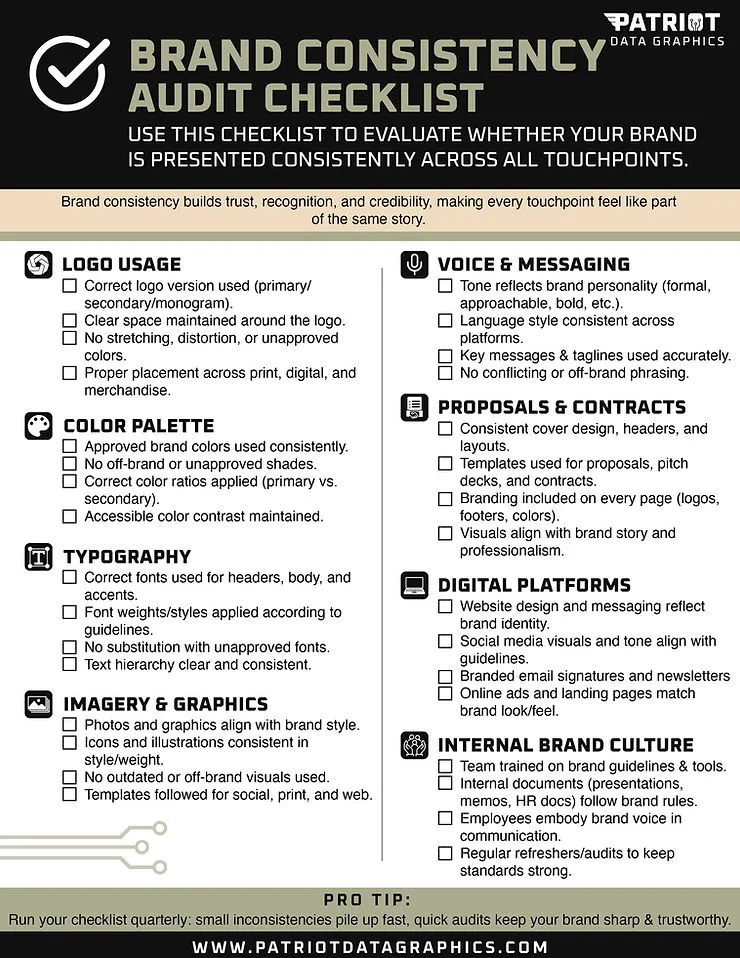
Before an organization can address brand debt, it must first measure it. The following framework provides a structured approach to identifying where and how severely fragmentation has taken hold.
Step one: Inventory every customer-facing touchpoint. This includes digital properties (website, social media profiles, email templates, digital advertising), physical materials (signage, packaging, print collateral, business cards), and experiential elements (customer service scripts, staff uniforms, event presence). The goal is comprehensiveness — partial audits produce partial pictures.
Step two: Evaluate each touchpoint against a defined brand standard. If no formal brand guidelines exist, this step requires establishing a baseline first. Assess visual consistency (logo usage, color, typography, imagery style), tonal consistency (voice, messaging hierarchy, value proposition language), and structural consistency (layout conventions, spacing, information architecture).
Step three: Map the deviations and assign a severity rating. Not all inconsistencies carry equal weight. A slightly incorrect font in a rarely accessed internal document is categorically different from a misrepresented logo on a high-traffic landing page. Prioritize remediation based on audience exposure and the severity of the deviation.
Step four: Trace each deviation to its source. Understanding why the inconsistency occurred is as important as identifying that it exists. Process failures require process solutions. Knowledge gaps require training solutions. Governance failures require structural solutions.
Paying Down the Debt: Where to Begin
The most effective approach to brand debt remediation is not a single large-scale overhaul — though that may eventually be necessary — but a disciplined, phased repayment strategy.
Begin with the highest-exposure, highest-severity inconsistencies and work systematically toward lower-priority items. Simultaneously, establish the governance infrastructure that will prevent new debt from accumulating: accessible brand guidelines, approval workflows for branded assets, and clear ownership of brand standards across the organization.
Engaging a qualified branding firm at this stage can accelerate the process significantly. Experienced brand strategists bring both the diagnostic capability to identify fragmentation that internal teams may have normalized and the design expertise to develop remediation assets that genuinely resolve rather than merely paper over the underlying inconsistencies.
The Strategic Case for Brand Discipline
Brand debt is ultimately a leadership issue. It accumulates in organizations where brand consistency is treated as a design preference rather than a business imperative. Addressing it requires elevating brand governance to the level of operational discipline — not as an aesthetic exercise, but as a direct investment in the coherence, credibility, and long-term equity of the business.
The companies that build durable, trusted brands in competitive US markets are not necessarily those with the largest creative budgets. They are the ones that understand the compounding value of consistency and treat every branding decision, however small, as an entry in a ledger that will eventually be audited — by their customers, if not by themselves.