Seeing Through the Cracks: How to Conduct a Brand Consistency Audit Before the Damage Becomes Irreversible
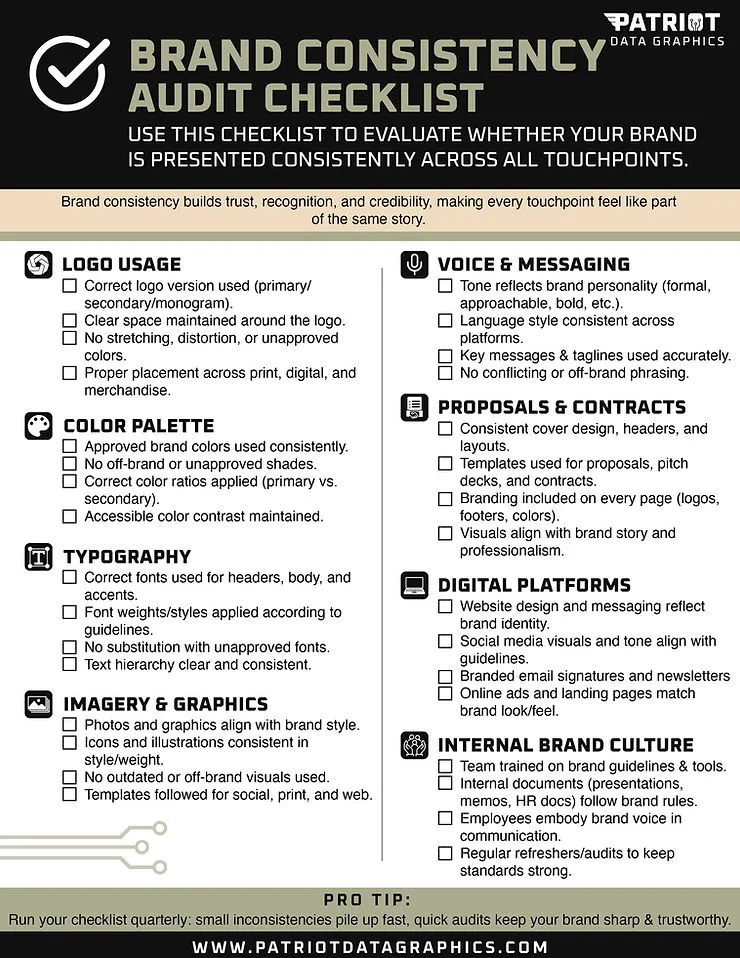
Photo: brand audit checklist business consistency review office, via static.wixstatic.com
There is a particular kind of organizational blindness that afflicts even well-run companies. It is not negligence, exactly. It is the natural result of growth — departments expanding, vendors multiplying, and brand assets spreading across dozens of hands without a single authoritative steward. The outcome is predictable: a brand that looks and sounds subtly different depending on where a customer encounters it.
Research from Lucidpress consistently finds that a majority of organizations — some studies placing the figure as high as 73 percent — struggle to identify their own brand inconsistencies until an outside party points them out. The implications are significant. Inconsistency does not merely look unprofessional; it actively undermines the psychological trust that brands work to build over years of deliberate effort.
For businesses serious about their market position, a brand consistency audit is not a luxury. It is a diagnostic necessity.
Why Inconsistency Is So Difficult to Self-Diagnose
The core problem is familiarity. Internal teams spend so much time inside a brand that they stop seeing it the way a first-time customer does. A slightly off-tone social media caption, a product label using last year's typeface, an email signature that predates the most recent logo refresh — these details become invisible to insiders.
Compounding the challenge is organizational fragmentation. In a company of any meaningful size, the marketing team controls the website, the operations team manages packaging specs, the sales department owns customer-facing presentations, and customer service representatives communicate through scripts written years ago. Each group optimizes for its own priorities. Nobody is watching the whole picture.
The result is what brand strategists sometimes call "brand drift" — a slow, almost imperceptible divergence from the intended identity that accumulates into something customers can feel, even if they cannot name it.
The Five Touchpoint Categories That Demand Scrutiny
An effective audit should examine every surface where a customer interacts with your brand. In practice, that means organizing your review around five core categories.
1. Visual Identity Execution
Pull every branded asset your company has produced in the past 18 months: website pages, social media graphics, print collateral, email templates, trade show materials, product packaging, and internal presentations. Lay them side by side — literally, if possible — and ask whether a stranger could identify them as belonging to the same company. Check for logo variations, inconsistent color values (RGB versus CMYK discrepancies are a common culprit), and typeface substitutions made out of convenience rather than intent.
2. Brand Voice and Messaging
Visual inconsistency is visible. Tonal inconsistency is felt. Review your website copy, social captions, customer service scripts, sales decks, and press releases. Does the language reflect a coherent personality? A brand that is conversational on Instagram but stiff and bureaucratic in its email communications creates a dissonance that erodes credibility, particularly with younger American consumers who are attuned to authenticity.
3. Digital Presence Alignment
Your website, Google Business Profile, LinkedIn page, and any other digital directory listings should present identical information — and more importantly, identical brand signals. Outdated taglines living on a forgotten microsite or a LinkedIn banner image from three rebrands ago are more common than most marketing directors would like to admit.
4. Customer Experience Consistency
This is the category most audits neglect entirely. Brand consistency is not solely a design discipline. The tone a customer service representative uses when resolving a complaint, the aesthetic of the unboxing experience, the language in an automated billing notification — these interactions are brand moments. Mapping the full customer journey and evaluating the brand expression at each stage frequently reveals the most surprising gaps.
5. Partner and Vendor Output
If external agencies, freelancers, or channel partners are producing branded content on your behalf, their output requires the same scrutiny as internally produced materials. A co-branded piece developed by a regional distributor that uses the wrong shade of your primary color is still representing your company to your customers.
A Practical Audit Checklist
The following checklist is not exhaustive, but it provides a reliable starting framework.
- Current brand guidelines document exists and is actively distributed to all content creators
- All logo files in use match the most current approved version
- Color values are specified in all relevant formats (HEX, RGB, CMYK, Pantone) and consistently applied
- Typography is consistent across digital and print applications
- Website, social profiles, and directory listings reflect current tagline and value proposition
- Customer-facing email templates have been reviewed within the past 12 months
- Customer service communication scripts reflect current brand voice guidelines
- Packaging and physical materials have been compared against current digital assets
- All external vendors have received and acknowledged current brand guidelines
- A single internal owner is accountable for brand standards enforcement
What Companies Discover When They Actually Look
The findings that emerge from a rigorous audit are often humbling. A mid-sized American software company that underwent a brand refresh in 2021 discovered, during a subsequent audit, that its sales team was still distributing pitch decks built on the pre-refresh template — complete with the old logo and a value proposition the company had formally retired. The decks had been downloaded, saved locally, and used autonomously for nearly two years.
A consumer packaged goods brand with regional distribution found that its West Coast packaging had been printed using a slightly different green than its East Coast packaging — a discrepancy that had crept in through a supplier change that nobody had cross-referenced against the brand spec sheet. The variance was subtle enough that no individual customer would likely notice, but it represented exactly the kind of accumulated carelessness that, over time, softens the precision a premium brand requires.
Both situations were correctable. But both had persisted far longer than they should have, precisely because no one had looked.
Turning Findings Into a Remediation Plan
Discovering inconsistencies is only half the work. The audit's value is realized in the remediation process that follows. Prioritize corrections by customer exposure: a homepage inconsistency affects every visitor; an internal presentation template is lower urgency. Assign clear ownership for each correction, establish a deadline, and — critically — update your brand guidelines to prevent the same gaps from recurring.
For companies that find the scope of inconsistencies overwhelming, this is precisely the moment to engage a professional branding firm. An outside partner brings the objectivity that internal teams structurally cannot, and experienced brand strategists have seen these patterns often enough to move remediation forward efficiently.
Consistency is not a cosmetic concern. It is a trust mechanism. Every touchpoint where your brand behaves as customers expect reinforces confidence. Every touchpoint where it does not introduces a small measure of doubt. Over thousands of interactions, that doubt compounds — and the companies that let it go unexamined eventually wonder why their customer loyalty numbers are softer than their product quality deserves.
